
How to Get Custom Tattoo Design That Fits You
- Jun 26
- 6 min read
Most bad tattoo ideas do not start as bad ideas. They start as vague ones. You know you want something dark, symbolic, maybe a little unsettling, but when it comes to explaining it to an artist, everything turns into "sort of this, but not exactly". That is usually the real question behind how to get custom tattoo design - not just where to ask, but how to arrive with enough clarity to get something original.
A strong custom tattoo is never pulled from thin air. It comes from a mix of your taste, the artist’s eye, the body placement, and a concept that can actually survive being turned into skin. If you want a piece that feels personal rather than generic, the process matters as much as the final drawing.
How to get custom tattoo design without ending up with a generic piece
The first thing to understand is that custom does not simply mean "made from scratch". Plenty of tattoos are technically redrawn but still feel recycled because the brief is weak or the artist is not the right fit. A proper custom design should feel like it belongs to you and still look like the work of the artist you chose.
That means you do not need to micromanage every line. You do need to know what you are drawn to. If your taste leans towards gothic imagery, folklore, mythic figures, religious iconography, bone structures, creatures, or darker illustrative work, say that plainly. If you like tattoos with heavy black, fine texture, or a more graphic silhouette, that matters too. An artist can build from direction. They cannot do much with "anything cool".
There is a trade-off here. The more open your brief, the more creative freedom the artist has. The more specific your brief, the more precise the outcome can be. Neither approach is better on its own. It depends on whether you are choosing an artist for their vision or commissioning a piece around a very fixed idea.
Start with the artist, not the idea
A lot of people begin with Pinterest boards and only look for an artist afterwards. That is backwards if you want a genuine custom tattoo. Style is not a minor detail. It shapes the mood of the piece, the way it ages, how readable it is from a distance, and whether the final tattoo actually feels alive.
If you want to know how to get custom tattoo design that feels right, start by finding an artist whose existing work already lives in the same visual world as your idea. Not someone who says they can do anything. Someone whose portfolio proves they already understand the atmosphere you want.
For darker custom work, that might mean looking for artists who already handle mythological subjects, blackwork, horror references, medieval ornament, woodcut-style texture, or surreal illustrative composition. If their portfolio is mostly fine line florals and minimalist scripts, do not try to force them into making your occult back piece. The result usually lands somewhere awkward in the middle.
When you choose the right artist first, you are not buying a finished image off a menu. You are buying their judgement, composition skills, and visual language. That is where the value is.
Bring references, but do not build a Frankenstein brief
References help, but only when they are used well. The point is not to hand over six tattoos and ask for them to be stitched together. That usually produces a design that feels borrowed, crowded, or oddly proportioned.
Better references show mood, texture, subject matter, and composition separately. You might have one image for the kind of antlers you like, another for cloak detail, another for the level of black shading, and another for the overall sense of menace. That gives the artist useful material without asking them to copy someone else’s tattoo.
It also helps to explain what you do not want. Maybe you like gothic imagery but hate overly polished realism. Maybe you want something feminine without it becoming soft or ornamental. Maybe you want mythological symbolism but nothing too literal. Those boundaries are useful.
Words matter as much as pictures here. A short, clear description often does more work than a giant mood board with no explanation.
Think about placement early
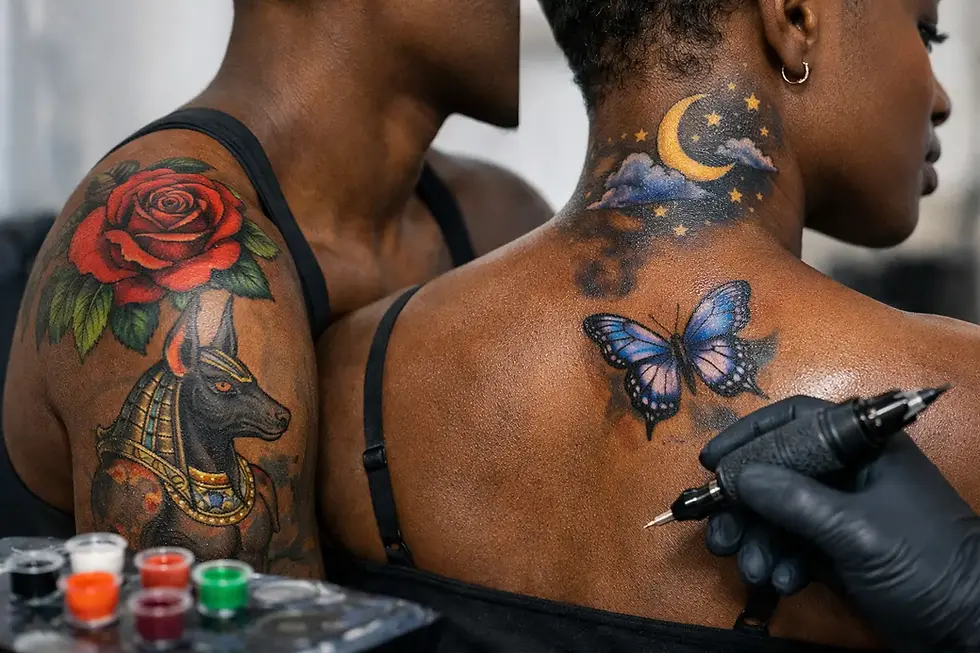
A tattoo design does not exist in a vacuum. It has to work on a body, and each part of the body changes what is possible. A rib piece moves differently from a thigh piece. A forearm demands readability. A backpiece can hold far more narrative and detail than the side of a calf.
This is where many people get stuck. They imagine a design as if it is going on paper, then realise too late that the level of detail will blur, the shape fights the anatomy, or the scale is too timid for the concept.
A good custom tattoo is designed with placement in mind from the start. Curved placements often need flow. Flat placements can take stronger symmetry. Smaller areas need simplification. Larger areas need enough visual weight to avoid looking lost.
If you are unsure on placement, ask the artist which body areas suit the concept best. That is not dodging the decision. It is using expert judgement. Sometimes the right answer is changing the size, not the design. Sometimes it is changing the placement altogether.
Be honest about meaning, but do not force symbolism
Not every custom tattoo needs a grand backstory, but it should have a reason behind it, even if that reason is simply aesthetic obsession. The strongest concepts usually have some emotional or symbolic anchor. That could be grief, transformation, protection, ancestry, fear, devotion, power, or fascination with a certain myth or creature.
The problem comes when people try to cram ten meanings into one piece. A raven, a dagger, a clock, a rose, a snake, a moon phase, and your star sign can all be meaningful, but meaning alone does not make a coherent tattoo.
Pick the imagery that actually carries the weight. Let the rest fall away. A single well-chosen symbol often feels more personal than a crowded design full of obvious references.
If you are commissioning a custom piece from an artist with a strong style, trust them to translate meaning into image. You do not need every detail to be literal. Suggestion is often more powerful than explanation.
Understand the custom design process
People often ask for a custom tattoo as if it works like ordering a logo. It does not. Every artist handles design slightly differently, but most proper custom work follows a similar rhythm.
First comes the enquiry. This is where you explain the concept, placement, approximate size, and any references. Then, if the project is a good fit, you book in. Some artists show the design in advance. Others show it on the day. Neither approach is automatically a red flag. It usually comes down to workflow and how much time is needed for revisions.
You should expect collaboration, but not endless rounds of redesign because you changed your mind three times. Custom design takes time. If an artist has a strong body of work, part of the process is trusting that they know how to turn your rough idea into something tattooable.
That said, you should still speak up if something feels off. Scale, readability, placement balance, and major content choices are all worth discussing. Tiny control-freak changes often make a design worse. Clear concerns make it better.
Budget affects options, not taste
Custom tattoos cost more than flash or off-the-shelf designs because you are paying for design time as well as tattooing time. That is normal. If your budget is tight, the answer is usually not to ask for a cheaper version of an ambitious concept packed with fine detail.
A better option is to simplify. A bold smaller piece can still feel striking and personal. A limited budget does not mean you need a bland tattoo. It just means you need a concept that matches the time available.
Be upfront about your budget if needed. A decent artist can often suggest ways to keep the spirit of the idea while adjusting scale or complexity. What tends to fail is pretending your budget can stretch to a full-day custom piece when it clearly cannot.
What makes a custom tattoo actually good
A good custom tattoo is not just original. It is readable, balanced, suited to the body, and built around imagery that has enough visual force to last. It should feel intentional from a distance and rewarding up close.
That is why custom work is worth doing properly. You are not just collecting symbols. You are building a piece of art that will live on you for years. The right artist will shape the idea, trim what is weak, push what is strong, and give it a form that works beyond the initial excitement.
If you are looking at artists in Southampton and your taste leans dark, illustrative and unapologetically individual, finding someone with a clear signature style will save you a lot of false starts.
The best way to get a custom tattoo design is to arrive with a point of view, choose an artist whose work already speaks your language, and leave enough room for real artistry to happen. That is when the piece stops feeling like a request and starts feeling like it was always meant to exist.