
15 Mythology Sleeve Tattoo Ideas With Teeth
- Aug 13
- 6 min read
A mythology sleeve should feel less like a row of pictures and more like a world climbing your arm. The strongest mythology sleeve tattoo ideas use familiar gods, beasts and symbols as raw material, then turn them into something personal, dark and properly built for the body. A skull-faced Hades, a drowned Ophelia-style siren, or a raven tearing through storm clouds can say far more than a clean copy of a museum statue.
The sleeve gives mythology room to breathe. It also gives every decision consequences: the central figure, the empty skin, the direction of movement, and how the piece looks when your arm is bent. Start with the story you want to carry, then choose the imagery that earns its place.
Start with the myth, not the Pinterest board
Mythological imagery has been tattooed for generations, which means the obvious versions are everywhere. Zeus with a lightning bolt, Medusa staring straight ahead, a Viking compass behind a warrior's head. None are automatically bad, but a sleeve needs a stronger point of view than simply fitting in every reference you like.
Ask what pulls you towards the mythology in the first place. Is it revenge, fate, transformation, grief, protection, the fear of death, or the idea of surviving a nightmare? That answer can shape the whole visual language. Greek myth lends itself to tragic faces, broken marble, serpents and theatrical movement. Norse stories bring harsher textures: blackwater, runes, ravens, knotwork, frost and beasts with real weight. Folklore often feels stranger still, with creatures that live at the edge of the woods or just outside the firelight.
A custom sleeve does not need to explain the myth to every stranger who sees it. It only needs to feel deliberate. At Neef Tattoos, that usually means allowing the darker, more unsettling part of the story to lead rather than smoothing it into something decorative.
Mythology sleeve tattoo ideas worth building around
1. Medusa as a curse, not a pin-up
Medusa works best when she has an emotional charge. Think cracked stone skin, tangled serpents disappearing into shadow, and a gaze that is confrontational rather than polished. Her snakes can coil naturally around the arm, making her ideal for a forearm-to-shoulder composition.
2. Hades and the gates below
A Hades sleeve can be all smoke, armour, skeletal hands and black architecture. Cerberus is a natural companion, but it need not be a clean three-headed dog portrait. Let one head emerge near the elbow, another vanish into the ditch, and use old coins, pomegranate seeds or dead branches to bind the underworld together.
3. Athena with an owl and ruined marble
For a sleeve with intelligence and menace rather than brute force, Athena offers a sharp direction. An owl in flight, a damaged Corinthian helmet and a weathered face can move through the upper arm without feeling like a history-book illustration. The owl's wings also make a useful transition into a shoulder cap.
4. A Norse raven omen
Ravens are simple at first glance, but their black forms can create dramatic movement across the arm. Pair them with a single watchful Odin-inspired figure, a blind eye, hanging branches or a battlefield haze. Keep the rune work restrained unless the runes themselves have been checked for meaning and accuracy.
5. Fenrir breaking free
Fenrir is built for a sleeve because chains, fur and jaws all wrap well around an arm. The story already carries tension: a beast bound because everyone fears what he will become. A torn chain crossing the elbow can look brutal, though dense detail over that joint will soften faster than detail on flatter skin.
6. The Morrigan in crow form
Irish mythology and folklore offer a darker route than the usual warrior-and-axe treatment. The Morrigan can appear as a shadowed woman, a carrion crow, or both at once. Use wet feathers, thorny brambles and battlefield fog to give the sleeve a haunted, graphic feel.
7. A Japanese oni emerging from smoke
An oni mask or full demon figure has huge visual impact, especially in blackwork or illustrative colour. Horns can frame the upper arm while smoke, flames or wind bars carry the design downwards. This works brilliantly when the sleeve is designed as one large creature rather than several disconnected motifs.
8. A dragon guarding something personal
Dragons exist across many traditions, so the key is choosing a specific cultural and visual direction. A coiling dragon naturally follows the arm's shape, while the object it guards can make the tattoo yours: a key, a severed crown, a mirror, a family symbol or an old house hidden in the scales.
9. Anubis and the weighing of the heart
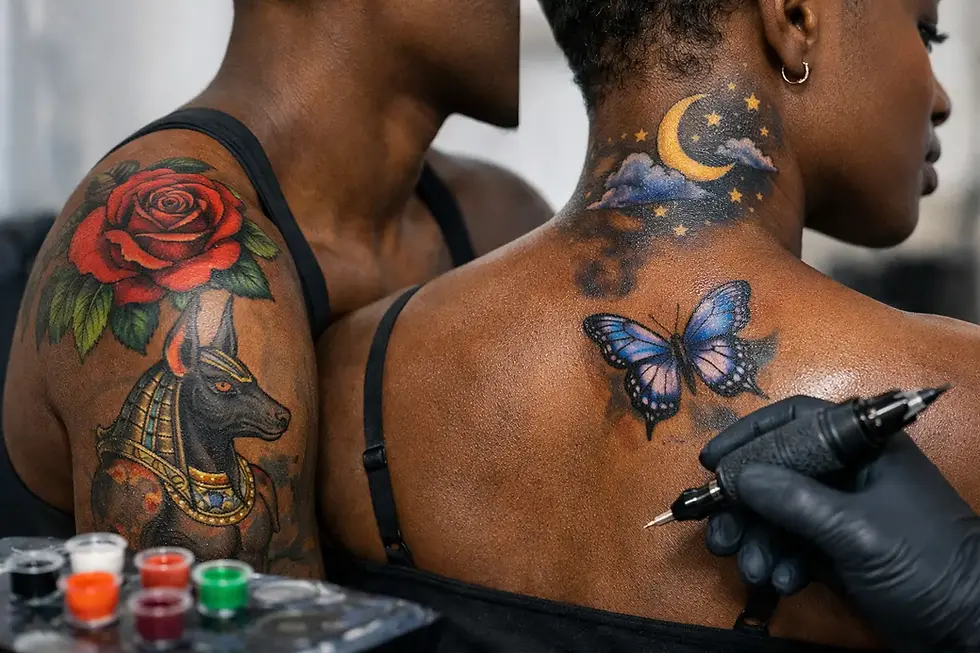
Anubis gives you strong contrast: the clean silhouette of a jackal head against scales, feathers, burial cloth and dark Egyptian ornament. The weighing of the heart introduces an idea of judgement without needing to spell it out. Avoid cramming every Egyptian symbol into the design. One clear scene has more power.
10. A serpent shedding its skin
Not every mythology sleeve needs a named god. The serpent is ancient, unsettling and adaptable, appearing in creation stories, underworld tales and transformation myths worldwide. A large snake peeling away from its old skin can travel from wrist to shoulder, with the exposed form becoming more monstrous as it rises.
11. The Minotaur in the labyrinth
The Minotaur is perfect for anyone drawn to monsters with a tragic core. A looming bull skull, fragments of a human face and maze-like stonework can create depth without literal map lines everywhere. Use the labyrinth as negative space or fractured architectural shadow, not as background filler.
12. Sirens beneath a black sea
A siren sleeve should feel cold, not cute. Give her drowned hair, sharp teeth, barnacles, skeletal fish or a shipwreck slipping into the background. Water can connect the entire arm beautifully, but it needs changing values and textures so it does not become one flat wash of blue-grey.
13. Baba Yaga's house in the woods
Folklore makes excellent sleeve material because it is odd, atmospheric and less overused. Baba Yaga's hut on chicken legs, surrounded by teeth, birch trees and a crescent moon, creates a storybook nightmare with plenty of space for black textures. It is especially strong for a dark illustrative approach.
14. Kali with skulls and severed time
Kali's imagery is powerful and culturally specific, so research and respectful design matter. Rather than treating sacred imagery as visual decoration, understand the meanings behind destruction, liberation and protection. If it resonates genuinely, a considered portrait with a skull garland and dramatic negative space can be extraordinary.
15. Your own invented pantheon
The best option is sometimes a myth that does not exist in any book. Build a false saint, a horned guardian, a moon-eating wolf or a relic from an imagined cult. You still get the scale and symbolism of mythology, but nobody else has the same story on their skin.
Make the sleeve flow like a single piece
A sleeve is not a scrapbook. The upper arm, elbow, forearm and wrist all move differently, so the design needs a hierarchy. Put the main face, creature or scene where there is room to read it clearly, often on the outer upper arm or outer forearm. Let secondary elements travel around the arm and use background only where it helps the eye move.
Elbows are best treated as transition points. Webs, smoke, scales, broken stone, fur and dark foliage handle the bend more gracefully than a detailed portrait. The inner arm can hold intimate symbols or more protected detail, but it is a sensitive area and often needs careful session planning.
Black and grey gives mythology a timeless, severe atmosphere, especially for gothic or horror-led designs. Colour can work just as well if it is controlled: oxidised green, blood red, bruised purple, old gold and sickly blue have more character than rainbow saturation. The trade-off is commitment. A large colour sleeve demands consistency across sessions and usually a clear palette from the start.
Give the artist material, then leave room for design
Bring references for mood, texture and subject matter, not a demand for an exact collage. A photo of a statue, a film still, an old woodcut and a sketch of a creature can communicate far more than twenty screenshots of existing tattoos. Also be honest about what you do not want. If you hate clocks, roses, ornate frames or hyper-realism, say so early.
Your artist should then shape the concept around your arm, skin tone, existing tattoos and tolerance for large dark areas. A full sleeve rarely needs to be completed in one heroic burst. Building it in considered sections can make financial and physical sense, provided there is a plan for how each stage will connect.
Pick the myth that keeps pulling at you after the trend has passed. Give it enough darkness, enough breathing room and enough of your own history that it could only belong on your arm.